
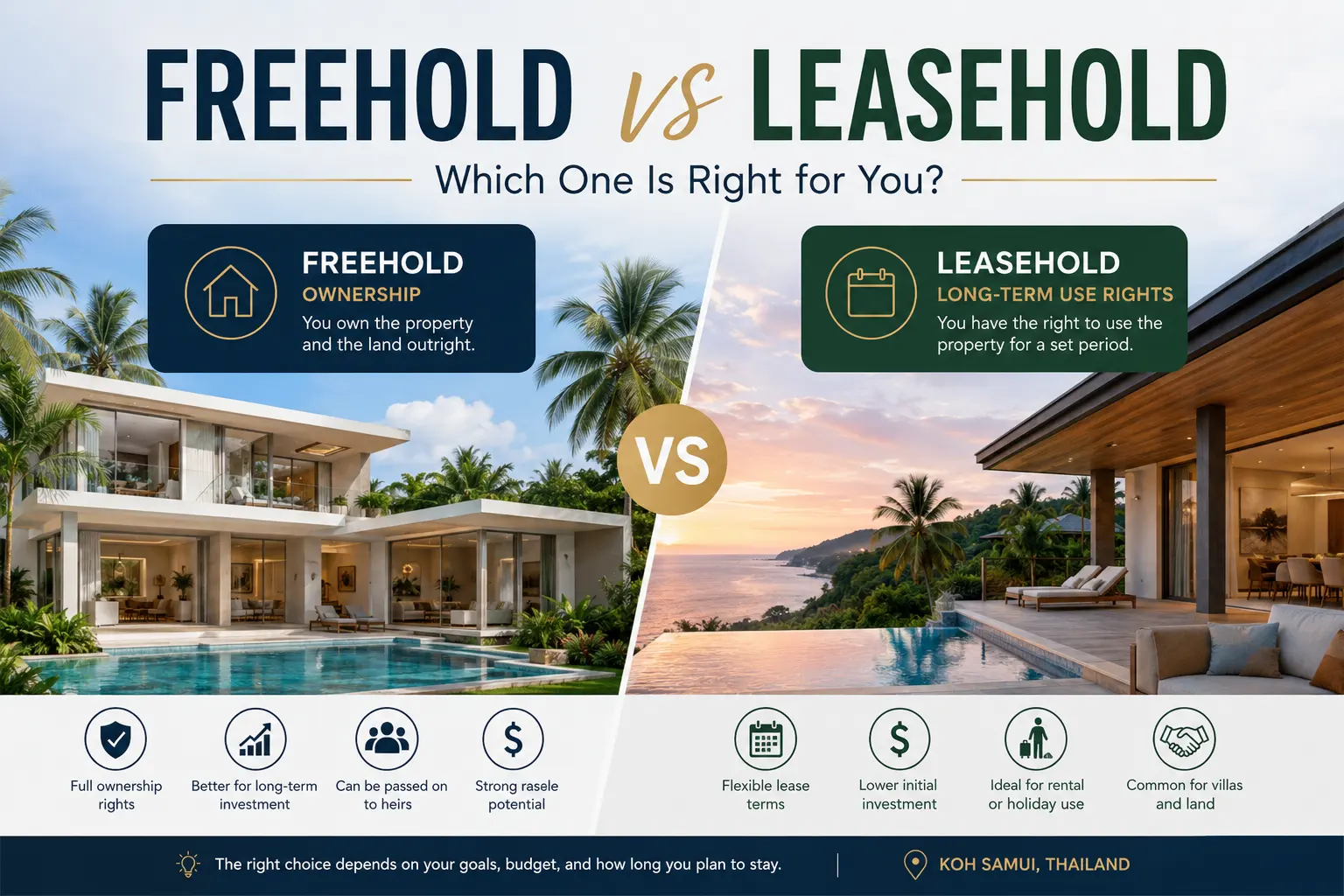
When buying property in Thailand, one of the key decisions to understand is whether the property is offered on a Freehold or Leasehold basis.
Both structures can be found in Thailand’s property market, including condominiums, villas, land-related investments, and resort properties. However, they provide different types of rights and come with different considerations.
There is no single option that is automatically better for everyone.
The right choice depends on your purpose, budget, intended holding period, investment strategy, and the type of property you are considering.
In this guide, we explain the key differences between Freehold and Leasehold property in Thailand and the important factors to consider before making a purchase.
What Is Freehold Property?
Freehold generally refers to ownership of the property itself, subject to the type of property and applicable laws.
With Freehold ownership, the owner holds the relevant ownership rights rather than simply having the right to use the property for a fixed lease period.
For example, a Thai buyer purchasing a house together with land under their own name may hold ownership of the land and buildings, subject to the applicable legal requirements.
Freehold ownership is also common in Thailand’s condominium market, where eligible buyers can purchase a condominium unit with ownership registered under the applicable condominium legislation.
Advantages of Freehold
Freehold ownership may be attractive to buyers who:
- Want long-term ownership
- Prefer to own rather than lease a property
- Are considering future resale
- Want greater control over the property
- Are looking for an asset that may be transferred to heirs
- Plan to hold the property for many years
However, Freehold does not automatically mean that every type of property can be purchased by every buyer. Ownership rights depend on the property type and applicable Thai laws.
What Is Leasehold Property?
Leasehold gives the buyer or lessee the right to use and possess a property for a specified period according to a lease agreement.
Unlike Freehold, Leasehold does not normally give the lessee ownership of the underlying land.
Instead, the rights are based on the terms and conditions contained in the lease agreement.
Leasehold structures are commonly encountered in Thailand’s property and hospitality markets, including certain villa, resort, commercial, and land-related arrangements.
Advantages of Leasehold
Leasehold may be attractive to buyers or investors who:
- Want long-term use of a property without acquiring the underlying land
- Are comfortable with a defined lease period
- Are looking for an alternative ownership structure
- Want to invest in certain resort or villa developments
- Are primarily focused on using the property or generating rental income during the lease term
However, the value of a Leasehold investment depends heavily on the lease agreement and the rights granted under that agreement.
Important terms can include the lease period, renewal provisions, transfer rights, subleasing rights, fees, and conditions relating to the property.
Freehold vs Leasehold: Key Differences
| Freehold | Leasehold | |
|---|---|---|
| Basic structure | Ownership | Right to use/possess for a defined period |
| Duration | Generally ongoing ownership, subject to law | Fixed period under the lease |
| Land ownership | May include land ownership where legally permitted | Lessee does not normally own the land |
| Resale/transfer | Depends on property and applicable law | Depends heavily on lease terms |
| Long-term holding | Often suitable | Depends on remaining lease term |
| Contract importance | Important | Extremely important |
| Foreign buyer considerations | Subject to specific legal restrictions | Often used where direct land ownership is restricted |
The table provides a general comparison. The actual rights and restrictions can vary depending on the property type, ownership structure, title, and contract.
Can Foreigners Own Freehold and Leasehold Property in Thailand?
Yes, but the legal conditions are different.
Foreign buyers can acquire certain types of property in Thailand through Freehold ownership or Leasehold arrangements, depending on the type of property and applicable Thai laws.
For foreign buyers, the key consideration is that Freehold and Leasehold are different legal structures, and the options available can vary depending on the type of property, ownership restrictions, and the intended use of the property.
Understanding these differences is essential for foreign buyers when choosing the most suitable property structure for their investment in Thailand.
What Should Foreign Buyers Know?
For foreign buyers, the distinction between Freehold and Leasehold becomes particularly important because Thai law places restrictions on foreign ownership of land.
Foreign buyers should therefore consider the type of property and the legal structure before making a purchase.
Condominium Freehold
Foreign nationals may be able to own condominium units on a Freehold basis, subject to the requirements of Thailand’s condominium laws, including the applicable foreign ownership quota.
This is different from owning land directly.
Land and Villa Ownership
Foreign nationals generally cannot directly own land in Thailand in the same way as Thai nationals, subject to limited exceptions under Thai law.
As a result, villa and land transactions involving foreign buyers may use different legal structures, including Leasehold arrangements or other structures that should be reviewed carefully by a qualified legal professional.
This is why foreign buyers should not assume that a property advertised as “Freehold” automatically means that the land can be registered directly in their name.
Which Is Better: Freehold or Leasehold?
There is no universal answer.
The better option depends on what you want to achieve with the property.
🏡 If you want long-term ownership
Freehold may be more suitable where legally available and where ownership is your primary objective.
🌴 If you are focused on long-term use
Leasehold may provide an alternative where owning the underlying land is not necessary or not legally available.
📈 If you are investing
Consider more than the purchase price.
Look at:
- Expected rental income
- Operating costs
- Remaining lease term
- Resale potential
- Location
- Demand from future buyers or tenants
- Exit strategy
👨👩👧 If you are buying for your family
Consider how long you expect to use the property and whether ownership can be transferred or inherited according to your objectives.
What Should You Check Before Buying?
Whether you choose Freehold or Leasehold, due diligence is essential.
Before committing to a property, consider checking:
1. Property Title and Ownership
Verify the relevant title documents and confirm who legally owns the property or land.
2. Contract Terms
For Leasehold properties, carefully review the lease agreement and all related documents.
3. Lease Period
Check the exact start and end dates of the lease.
Do not rely solely on marketing terms such as “30-year lease” without reviewing the actual contract.
4. Renewal Conditions
If the property is marketed with potential renewal periods, carefully review how those renewals are structured and whether they are legally enforceable.
5. Transfer and Resale Rights
Check whether the rights can be transferred to another person and what conditions or fees may apply.
6. Additional Costs
Consider taxes, transfer fees, registration fees, maintenance fees, management fees, legal fees, and other costs associated with the transaction.
7. Professional Legal Review
For significant property purchases, especially transactions involving land, Leasehold structures, or foreign buyers, obtaining independent legal advice is strongly recommended.
Freehold vs Leasehold in Koh Samui
Koh Samui has a diverse property market, ranging from land and private pool villas to condominiums, resort residences, and investment properties.
As a result, buyers may encounter both Freehold and Leasehold structures.
For buyers considering a villa or land investment in Koh Samui, it is particularly important to understand exactly what is being purchased, what rights are being transferred, and how those rights are documented.
The most suitable structure can vary depending on whether you are:
- Buying a holiday home
- Planning to live in Koh Samui
- Purchasing a rental property
- Investing in an off-plan villa
- Looking for a long-term property investment
- Buying as a Thai national or foreign national
Rather than choosing a property based only on whether it is advertised as “Freehold” or “Leasehold,” buyers should look at the complete legal and financial picture.
Final Thoughts
Freehold and Leasehold can both be viable options in Thailand’s property market.
Freehold generally focuses on ownership, while Leasehold provides rights to use and possess a property for a specified period.
The right choice depends on your goals, budget, intended use, investment strategy, and the specific property involved.
For both Thai and foreign buyers, understanding the ownership structure before signing a purchase or lease agreement can help avoid unexpected issues later.
And when investing in a property in a market such as Koh Samui, the legal structure should be considered just as carefully as the location, price, design, rental potential, and future resale prospects.
Always review the property documents and seek qualified legal advice before entering into a property transaction.
🌴 Looking for Property in Koh Samui?
Whether you’re looking for a Freehold property, Leasehold villa, land, condominium, or investment opportunity in Koh Samui, we can help you explore available options based on your requirements.
Contact Success Property Thailand to discover available properties and investment opportunities in Koh Samui.


Join The Discussion