
Source of Funds in Thailand: What Property Buyers Need to Know Before Buying High-Value Property
If you are planning to buy property in Thailand, whether it is a house, villa, land, condominium, or other high-value real estate, preparing the financial side of the transaction is an important part of the process.
One area that buyers, sellers, and real estate professionals should understand is Source of Funds.
Having enough money to purchase a property is one thing. Being able to explain the legitimate origin and movement of the funds, where relevant, is another.
For high-value property transactions, financial institutions, real estate professionals, and other businesses subject to Thailand’s anti-money laundering requirements may have reporting and customer due diligence obligations depending on the nature and circumstances of a transaction.
Understanding Source of Funds in Thailand before the transfer date can therefore help buyers prepare the appropriate financial records and reduce the possibility of unnecessary delays.
What Is Source of Funds?
Source of Funds (SoF) refers to the origin of the money being used for a particular transaction.
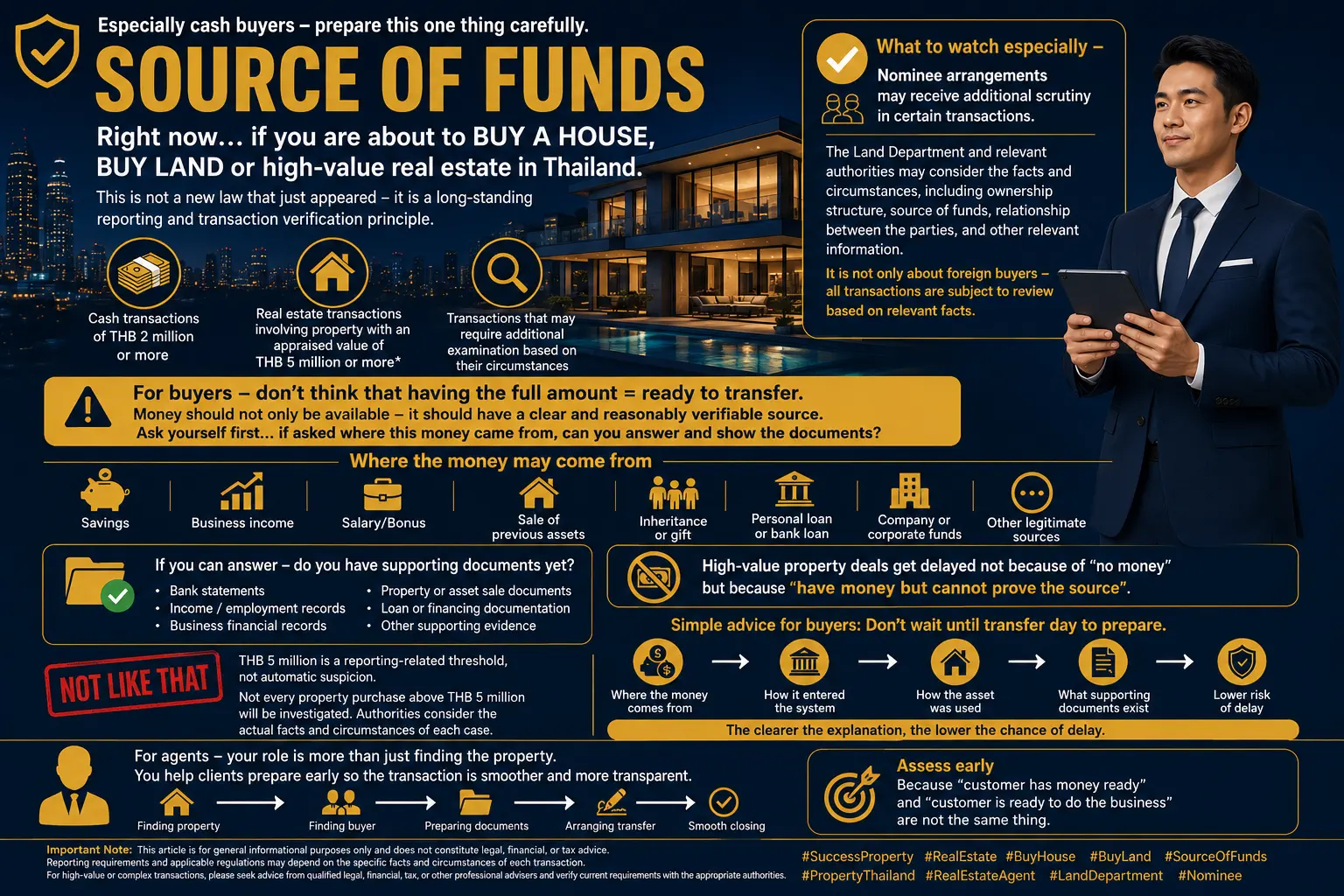
For a property purchase in Thailand, the funds may come from a variety of legitimate sources, including:
- Personal savings
- Salary, bonuses, or employment income
- Business or investment income
- Sale of another property or asset
- Bank financing or a mortgage
- Inheritance or gifts
- Funds transferred from another individual
- Company or corporate funds
- Other legitimate financial sources
The important issue is not simply whether the buyer has sufficient money available.
Depending on the transaction and circumstances, there may also be a need to understand where the money came from, how it moved through the financial system, and whether supporting documentation is available.
Source of Funds and Property Transactions in Thailand
Thailand has long had rules concerning the reporting and examination of certain financial transactions under its anti-money laundering framework.
These rules are not a new requirement created specifically for people buying property in Thailand.
Certain transaction thresholds and circumstances may be relevant. For example, the Anti-Money Laundering Office (AMLO) states that cash transactions of THB 2 million or more may fall under cash transaction reporting requirements, while transactions involving property with an appraised value of THB 5 million or more can fall under property transaction reporting requirements where the applicable rules apply.
However, these figures should not be interpreted as meaning that every person buying property above THB 5 million will automatically be investigated or considered suspicious.
The relevant authorities and reporting entities may consider the actual facts and circumstances of the transaction, including the nature of the transaction, the parties involved, the source of funds, ownership structure, and other relevant information.
Therefore:
THB 5 million is a reporting-related threshold in certain circumstances — it is not an automatic suspicion threshold.
A property transaction above THB 5 million does not, by itself, mean that the buyer has done anything wrong or that the transaction will automatically receive additional scrutiny.
Why Should Property Buyers Prepare Their Financial Trail?
When buying a high-value property in Thailand, it is useful for buyers to understand the financial trail behind their purchase.
In simple terms:
Where did the money come from → How did it enter the financial system → How is it being used → What documents support the source?
For example, if the purchase funds come from personal savings, bank statements and income records may help demonstrate how the funds were accumulated.
If the money comes from the sale of another property, documents relating to that sale may help explain the source.
If the purchase is financed through a bank loan, loan or financing documentation can help establish the origin of the funds used for the purchase.
The exact documents that may be relevant depend on the circumstances of each transaction.
What Documents Can Help Support the Source of Funds?
There is no single document that applies to every property buyer.
The appropriate supporting records depend on where the purchase funds originated.
Examples may include:
- Bank statements
- Employment or income records
- Salary or bonus records
- Business financial records
- Property sale agreements
- Evidence of asset sales
- Loan or mortgage documentation
- Company financial statements or corporate records
- Documents showing transfers between accounts
- Inheritance or gift documentation, where applicable
- Other records demonstrating the legitimate origin of funds
The purpose is to maintain a clear and reasonably verifiable financial trail.
This can be particularly useful when a high-value property transaction involves large amounts of money moving between different bank accounts, individuals, companies, or countries.
Having the Money Is Not Always the Same as Being Ready to Complete the Transaction
One of the most important points for buyers is that having sufficient funds does not necessarily mean every aspect of a high-value property transaction is ready.
For example, a buyer may have a substantial amount of money in a bank account but have limited documentation showing how the funds were accumulated or transferred.
Another buyer may have a clear financial history supported by bank statements, income records, property sale documents, or loan documentation.
The difference is not necessarily the amount of money available.
It can be the ability to provide a clear and reasonably understandable explanation of the financial trail when documentation is required.
This is why preparing relevant documents before the property transfer can be helpful.
Source of Funds for Foreign Property Buyers in Thailand
For foreign buyers purchasing property in Thailand, financial documentation can become particularly important when funds originate overseas or pass through multiple financial institutions.
International property transactions may involve:
- Overseas bank accounts
- International money transfers
- Currency exchanges
- Transfers between different financial institutions
- Multiple sources of funds
- Company or corporate accounts
- Funds transferred between family members or other individuals
In these situations, keeping records of the movement of funds can make the transaction easier to explain if questions arise.
Foreign buyers should also ensure that the proposed ownership structure and method of acquiring the property comply with applicable Thai laws and regulations.
This is particularly important when the transaction involves land ownership or a more complex ownership structure.
Another Important Issue: Nominee Arrangements in Thailand
Another issue that has received attention in Thailand’s property market is the use of Thai individuals or entities to hold land on behalf of foreign nationals, commonly referred to as nominee arrangements.
Such arrangements may receive additional scrutiny in certain transactions, depending on the facts and circumstances.
Relevant authorities may consider factors such as:
- Ownership structure
- Source of funds
- Relationship between the parties
- Financial arrangements
- The actual person controlling or benefiting from the property
- Other relevant facts and circumstances
This means that a transaction should not be viewed simply as:
“The buyer has the money and the documents, so the transfer should automatically be straightforward.”
The wider circumstances of the transaction may also matter.
Importantly, this issue is not limited to the idea that every foreign buyer will be subject to additional scrutiny. The circumstances of each transaction are relevant.
What Should Property Sellers Check?
For sellers of high-value property in Thailand, checking whether a buyer has sufficient funds is only one part of preparing for a transaction.
It may also be useful to consider whether the transaction is properly documented and whether the buyer can reasonably explain the source of the purchase funds if relevant questions arise.
This does not mean that property sellers should act as investigators or assume that every high-value transaction is suspicious.
Rather, it is about ensuring that both parties are properly prepared before entering into a significant property transaction.
Preparing relevant documentation early may help reduce unnecessary delays or complications later in the transaction and transfer process.
Don’t Wait Until the Property Transfer Date
If you are planning to buy a house, villa, land, condominium, or other high-value property in Thailand, it is better to consider your financial documentation before the transfer date.
This becomes particularly useful when the purchase funds:
- Come from multiple sources
- Are held across several bank accounts
- Have been transferred between individuals
- Come from the sale of another asset
- Involve a company or legal entity
- Originate from overseas
A clear financial trail can make it easier to explain the transaction if supporting documentation is requested.
In simple terms:
The money should not only be available — its source should also be clear and reasonably verifiable where required.
What Does Source of Funds Mean for Real Estate Agents?
Source of Funds is also relevant to real estate agents and property professionals in Thailand.
An agent’s role is not simply:
Find the property → Find the buyer → Close the sale → Arrange the transfer
For high-value property transactions, agents may also need to consider their own applicable reporting and customer due diligence obligations and help clients understand what information or documentation may need to be prepared.
Thailand’s AMLO publishes specific guidance concerning transaction reporting for professionals under Section 16(4), including brokers or agents involved in buying and selling real estate.
However, agents should avoid providing legal, financial, or tax advice beyond their professional expertise.
The distinction is important:
“The client has the money”
and
“The client is ready to complete the transaction”
are not necessarily the same thing.
Being prepared from the beginning — particularly regarding source of funds, financial documentation, and ownership structure — can help make high-value property transactions more transparent and smoother for everyone involved.
How Buyers Can Prepare for a High-Value Property Purchase in Thailand
Before purchasing a high-value property, buyers can consider taking the following steps:
- Identify the source of the purchase funds.
- Keep relevant bank statements and financial records.
- Maintain documentation showing the origin of significant funds.
- Keep records of transfers between accounts.
- Prepare documents relating to property or asset sales where applicable.
- Keep loan or financing documentation if applicable.
- Keep relevant inheritance or gift documentation where applicable.
- Review the proposed ownership structure before proceeding with the transaction.
- Consider whether funds originating overseas can be clearly traced through the relevant accounts.
- Seek professional advice where the transaction involves complex financial or legal arrangements.
Preparing early is generally easier than trying to reconstruct a financial history after a transaction has already started.
Why Early Preparation Can Help
High-value property transactions can involve significant sums of money and multiple parties.
A transaction may involve the buyer, seller, real estate agent, bank, lawyers, financial institutions, government offices, and other professionals.
When financial documentation is prepared in advance, it can help answer basic questions more efficiently:
Where did the money come from?
How did the money enter the system?
How was the money transferred?
What is the money being used for?
What documents support the explanation?
The clearer the financial trail, the easier it may be to explain the transaction when relevant documentation is required.
Final Thoughts for Property Buyers in Thailand
Buying a high-value property in Thailand involves more than simply finding the right property and having enough money to pay for it.
Understanding Source of Funds in Thailand, maintaining appropriate financial documentation, and considering the ownership and transaction structure can help buyers prepare more effectively.
For foreign buyers, sellers, and real estate professionals, these considerations can be particularly relevant when a transaction involves large amounts of money, overseas funds, multiple accounts, corporate structures, or land ownership.
The key takeaway is simple:
Having the money and being prepared to complete the transaction are not always the same thing.
Preparing the financial trail before the transfer date can help reduce avoidable delays and make the overall property transaction more transparent.
If you are planning to buy property in Thailand, particularly land, a villa, house, condominium, or other high-value real estate, consider preparing the relevant financial documentation well in advance.
Important Note
This article is intended for general informational purposes only and does not constitute legal, financial, tax, or investment advice.
Reporting requirements, customer due diligence obligations, and other applicable regulations may depend on the specific facts and circumstances of each transaction and the parties involved.
The thresholds and examples mentioned in this article relate to reporting requirements under applicable Thai anti-money laundering rules and should not be interpreted as meaning that every transaction above a particular amount will automatically be investigated or considered suspicious.
For high-value or complex property transactions, buyers, sellers, and property professionals should seek advice from qualified legal, financial, tax, or other relevant professional advisers and verify the current requirements with the appropriate Thai authorities.



Join The Discussion